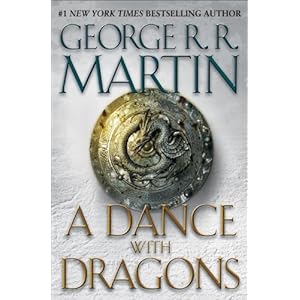
 The reread of "A Dance with Dragons" is now complete, and it was a fun journey. I developed a deeper understanding of the book, the characters in it and the greater story arc involved. This blog will not publish new posts after this one. You can continue to read work from me on The Tower of the Hand. The comments for posts on this blog will stay active, and I will continue to answer them. That being said, let's return to the issue at hand: a review of "A Dance with Dragons" after it has been reread. To say the least, the second read was a whole lot different from the first read. That was of course true of the other books as well, but in the current volume a number of issues fell together, making the statement necessary. There was a lot of hate out there after people had read the book, and I joined into some of it especially regarding the chapters taking place in the east. That was, I have to admit however, unjustified. "A Dance with Dragons" is a piece of art, much like the other books, and the widespread disappointment could not have happened like that if not for unrealistically high expectations. I confess myself guilty on that account too, of course.
 The expectations were unrealistic simply because we knew from the start that the book would be the second part of what was "A Feast for Crows", which gave way to the same disappointed expectations only to be later redeemed after it had sunk into people's mind and reread several times. It's much the same with "A Dance with Dragons". When I stated earlier that it was "a piece of art", I meant it. Martin's writing skills, the great characters and the general storyline aside, are visible throughout the whole book. We already know his stunning ability to tell the story from the point-of-view of his characters, to play with the knowledge they have, with rumors and predjudices. This challenges the reader to question what he thinks he knows, and to gather the whole picture together from various sources and inclinations.
In "A Dance with Dragons", another style element of Martin's writing is even more visible than just the POV-perspective. He manages to hide things that happen between the lines, so they are only recognizable by the keen eye of the reader. You have to pay close attention to details, you have to have previous details from previous details in mind, and you have to have a feeling for the overall world. This, one could argue, makes reading "A Song of Ice and Fire" more work than just skimming through your everyday Twilight novel. It is much more rewarding, however. Just a few examples of things you miss on your first read, which are between their lines and for which you have to pay close attention: Arya killing her victim with a poisoned coin, Wyman Manderly killing the Freys and baking them into pies, Dany miscarrying a child in her last chapter and the possible fulfillment of the Azor-Ahai-prophecy in Jon's last chapter. All these things are there, and once you know they are they suddenly seem to jump into your face (think of Manderly singing a song about the Ratcook!). You most certainly miss them the first time, however. These novels are puzzles that need to be solved and fit together, and it challenges you and makes the read so much more rewarding.
Of course, these puzzle pieces are not everything that you can find in "A Dance with Dragons", to be sure. When I first reviewed the book after my first read, I thought that the overall theme was failure, since no one really succeeds with what he wants: Jon with his wildling peace, Dany with her Yunkish peace, Victarion, Tyrion and Quentyn with their quest for Dany, and so on. That is, however, not exactly true. The first important thing to consider when you read "A Dance with Dragons", a thing that easily gets out of your mind, is that it is the second part of "A Feast for Crows", and it works only to its full extent combined with the previous novel. There are several themes that span across both books. We will explore them in a moment. These themes, in any case, are interwoven between the chapters and affect several characters, and these characters solve their part of the respective theme differently. You as reader can compare their approaches and results before the story culminates, also a bit hidden between the lines, in the final chapters of "A Dance with Dragons" and prepares the stage for "The Winds of Winter".
The first theme that is explored in the two books is ruling the peace. Three characters share this arc, supported by some others. The three characters are Cersei (in "A Feast for Crows"), Jon and Daenerys (in "A Dance with Dragons"). All three of them only recently came in power, and all three of them face the end of a war and a delicate, unstable peace. Their approaches radically differ. The outcomes don't; they all lose their power at least temporary. Jon and Daenerys are at opposite ends of the compromise spectrum: Jon is uncompromising and forces his vision of the peace through against all resistance. In the end, his brothers are left behind by his policy, not convinced or adequatly informed about it, and turn against him. Daenerys, on the other hand, compromises to the point of self-denial. She accepts the point-of-view and the sensibilities of the Meereenese, leaving her own power base in the dust and betraying all her ideals. In the end, it is hard to decide if Meereen is her city at all, or if she just restored it completely. Cersei, of course, uses the power she has in an entirely different way. She thinks she has to display force, which is right to a degree, but chooses the wrong opportunities and wrong styles for it - most notable in her decision to cease payments for the Iron Bank.
Supporting characters for these story arcs are Jaime Lannister, who serves as an eye on Cersei's madness, draws the conclusion that he doesn't want to have anything to do with the downfall in King's Landing and leaves. There is Barristan Selmy, who advises Daenerys and with surprising capability takes up the rulership after her disappearance. And there is Melisandre, trying to guide and warn Jon, suffering from the fact that she needs guidance as well since her reading of the fires most certainly is wrong regarding Azor Ahai.
The second theme is the journey to yourself. Several characters are on the road, mainly Tyrion, Brienne, Quentyn, Bran and Arya. They are all lost in a way, trying to find a meaning, a purpose, and a new approach to their very self. This story arc is most developed in Tyrion, and least developed in Quentyn, but that is mainly a product of the pages these characters get and the purpose they serve for the overall story. Let's start with the characters with the fewest chapters. Surprisingly, and for me at least disappointingly, Bran only got three chapters. The journey to the Three-Eyed-Crow is finished in the first, which really comes to a surprise after the long journey through the North displayed in "A Storm of Swords" (which should silence those who claim that Martin just puts endless descriptions in the book to lengthen it. Why not here?). In the second and third chapter, he learns that his powers are even greater than he thought and what true greenseeing is like. His character development is drastic: he severes himself from Jojen and Meera, uses Hodor as a tool more and more and fully embraces a fate as greenseer, which could very well involve to grow into a tree and never to leave again, becoming like one of the old gods himself.
Quentyn, a new character, only has four chapters. They are mainly a deconstruction of the classical knight's tale, since he fails consequently. Through his eyes, we see the fall of Astapor, though, and learn about the working mechanisms of a mercenary company. He also releases the dragons in the end, thereby changing the dynamics. He never really becomes self-aware, though, thinking that he has a destiny to fulfill that clearly is not his. Brienne is searching for a new purpose. Her quest for Sansa Stark is, the reader knows, futile, since Sansa is in the Vale. Through her eyes we experience the full implications of war on the smallfolk and the daily hardships and injustices that these people have to endure. Brienne is forced to reflect about her image of knighthood and the idealized image from the songs and stories and to finally discard it, which is another theme that drags throughout all the books, especially in Sansa's story arc. Arya, after her journey through Westeros, finally reached Braavos and starts her training as an assassin, but it doesn't feel right. Should she go through with it, her character would cease to exist, which seems unlikely to happen. For now, however, she evolves into quite a different thing than she was in the beginning.
Lastly, there is Tyrion. In my initial review, I stated that his chapters are disappointing, dragging endlessly as kind of an Essos road movie. This is at most half-true, however. Tyrion is the character that is most profoundly lost, and his chapters reflect that. At the beginning of "A Dance with Dragons", he is permanently drunk, shoved around by everyone and pushed and pulled into directions, willingly submitting to whatever path is layed out before him. On the journey with Connington and Aegon, he finds much of himself again but is still plagued by his inner demons and without his own impetus. It takes his captivity and enslavement to reactivate the old Tyrion. At the end of "A Dance with Dragons", Tyrion is grasping opportunities, found his wits again and takes control of even the most desperate situations - most like he did back in "A Game of Thrones".
These themes are placed very strongly in the books, but it is nevertheless not easy to discover them, especially since they are spread over two books that need to be read as a unity. Only regarding these themes it becomes understandable that two things one would have expected to play a role in this book in fact don't: the Others and the dragons. The Others never even make an appearance again after having been featured so heavily in "A Storm of Swords", and the dragons are either chained or fled early in "A Dance with Dragons" and continue to play a role only in the final stages of the book. Several people have expressed doubts whether the Others would, after his pause in their appearance, pose a conceivable thread in "The Winds of Winter" or if they would just be viewed as a convenient plot device. Again, one has to read carefully and aware. Throughout Jon's chapters, the threat of the Others is always there. They make no appearance, but the wildlings - who refuse to talk about it - where seriously attacked by them in the aftermath of the battle with Stannis, and everything Jon does - really everything - is driven by the knowledge that the Others are out there and that they are in a fight of life vs. death. His failure is to realize all this and to do nothing to convince others, mainly Bowen Marsh, of it.
Other themes are more woven in the narrative and more difficult to find. This is especially true for the prophecies. To really grasp everything going on in that respect, you have to not only keep in mind all the prophecies that were muttered throughout the four previous books - word for word - but also really look out for small details. The fuflfillment of the Azor-Ahai-prophecy in Jon's last chapter is such a thing. Ser Patrek of the Mountain sports a big star as sigil and gets beaten to bloody pulp, therefore we have a bleeding star, Jon's wounds smoke and Marsh is crying, so we have salt in his tears. Now Jon only needs to survive somehow and/or be reborn, and we have the propehcy fulfilled in the unlikeliest manner imaginable. Such small details - which may be, keep in mind, totally meaningless distractions - can be found through all the book.
The attention to such details and the careful orchestration of every event and character development are what makes "A Dance with Dragons" such a piece of art. I know really and totally understand why Martin needed so long to complete this. It's not only the story itself, like I first suspected, which is complicated enough in its own right. All the small things and details that all add up and fit must have given him real nightmares and pose a logistical nightmare without precedent. I am humbled after my second read, and are more convinced than ever that Martin knows what he is doing and that all the ordeal of waiting is worth it. I was wrong not to trust him, and so were all who until now think that "A Dance with Dragons" is the weakest book of the series. This is my sincere opinion. I repent, and I make ammends. And I can't wait for "The Winds of Winter", which I will then hopefully not burden with expectations that it can't and quite frankly shouldn't fulfill.


Hiç yorum yok:
Yorum Gönder